• About
    • About
    • Contact

The ReNEW Blog

  • Do you Believe what you Believe?

    August 23rd, 2023

    Part Two: The Church and its Words

    I’ll never forget that Sunday morning.

    I’m sitting in church and, for maybe the 5,000th time, we came to that point in the service where we all stand and recite what we call “The Creed.”

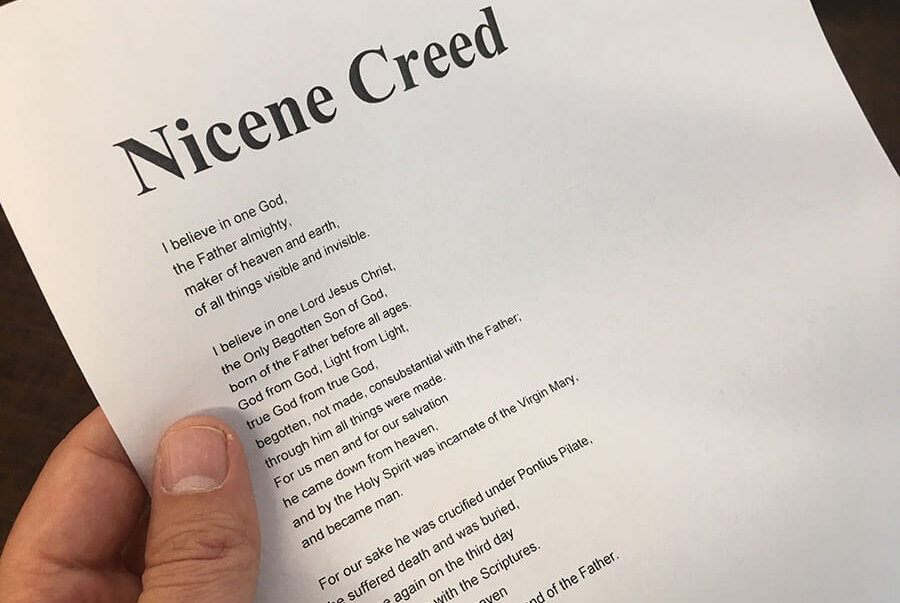
    Which generally means one out of two options: The Apostle’s Creed or The Nicene Creed. (There are other Creeds, but these two are the most recited Christian Creeds worldwide.)

    If you didn’t grow up in church, all you need to know about The Creeds is that they were ancient “statements of Belief” (the word “Creed” literally means “I Believe”) that church fathers from the first few centuries constructed to pull together the core tenants of the Christian faith.

    But more importantly, the primary reason the Creeds were written was to combat and correct heresies that had been floating around regarding things like Jesus’s divinity, Jesus’s humanity, the role of the human body, the nature of the Trinity, etc.

    So, to ensure that all Christians would be “on the same page” about what they should “believe”, they drew up a statement about what was most important in Christianity.

    The kind of stuff that, if you didn’t “believe” parts of it, you really had no business calling yourself a Christian.

    Here’s a sample from the Apostle’s Creed:

    I believe in God the Father almighty, Maker of heaven and earth,

    and in Jesus Christ, His only Son, our Lord…

    ….I believe in the Holy Spirit,

    The Holy Christian Church,

    The communion of Saints,

    The forgiveness of sins,

    The resurrection of the Body,

    And the life everlasting….

    Now, before I go any further, please know that my intention is not to “bash” these ancient Creeds. Personally, I think it’s pretty cool when we, as a church, say in unison something that millions of other Christians are saying around the world at that same moment (in thousands of different languages), and what BILLIONS of Christians that came before us had recited over the broad history of the church.

    There certainly can be a unifying effect. In fact, many people forget that the Creeds are not prayers. Meaning they are not directed towards God, but towards each other, to remind ourselves and the church what we “believe.”

    Now, why do I keep putting “believe” in quotations?

    Let’s get back to that Sunday in church.

    For whatever reason, in the middle of reciting all the “I Believes,” a question popped into my head: “Do I actually believe all of this? Do the people in the pews around me actually believe all of this?”

    And, as you might imagine, these questions were closely followed up with the far more important, semi-philosophical question:

    “What is belief?”

    Or….“What does it mean to ‘believe’ something? Does believing something mean just saying it out loud? Does it mean taking something that someone has said you should believe and, even if you’re still not 100% sure about it, you recite it over and over and over again until you eventually agree with it?”

    I couldn’t answer that question.

    And because I couldn’t define belief, as you might imagine, I was unable to conclude whether or not I believed the things I was sayingout loud that I believed.  

    By the time I got out of my own head, I realized the Creed was over, and I was the only one in the room still on their feet. Awkward.

    Have you ever wrestled with that question? When you say you ‘believe’ something (whether it’s a belief in God, a belief in humanity, or a belief ‘in a thing called love’ (to quote an obscure band from my high school days), what are you actually saying?

    If you feel you have a firm grasp on this, then read no further. I’m serious. I don’t want to waste your time.

    But if you’re like me, and those philosophical questions eventually bubbled to the surface of your mind and you simply could not ignore them any longer, then walk with me a bit more.

    If you recall from last week, my definition of belief (which has clearly evolved since that awkward day in church) has now lined up with arguably the most faithful Biblical definition:

    To believe something means you live your life in such a way that you trust and expect the thing you believe in to come to pass. And that the only way to truly reveal whether or not you ACTUALLY believe something (or not), is in the arena of life experience.

    In other words, my true belief in the safety of driving a car can only be revealed the moment I actually get in my Toyota and drive on the freeway without even thinking about it.

    We also covered what belief is NOT:

    -It is not simply receiving information about something and deciding internally that I agree with it.

    -It is not something I work hard to intellectually “muster up” or assent to

    -It is not declaring to a group of people that I believe what I believe

    (We also used the driving analogy negatively here to show how ridiculous it would be if someone said they “believed” in the power of driving, but never actually got out onto the road).

                So, how does this definition of “belief” fit within the context of a church?

                Well, ironically, as beautiful and articulate as our Creeds are, they also can create a dangerous roadblock for us to truly believe what we’re reciting.

                Why?

                Because if our church is operating under a misguided definition of belief, then that will determine what kind of church we will be.

                If the underlying implication is that all that belief amounts to is professing certain words with our mouths in a public setting, then our beliefs never need to make it down to the level of our hearts, minds, or bodies. I can simply profess I believe something forever without having to test or verify it in real life.

                But the mind is a beautiful, tricky thing, And it’s very possible that (as in my case) the cognitive dissonance will eventually catch up with us, and we will realize that there is a disconnect between what we’re professing to believe and what we truly trust and expect.

                And then we have a choice.

                We can either address it or find a way to justify it. Our minds and wills only have those two options.

                To choose the latter is the beginning of what some call the “Double-Life.” And in the case of the Christian, it’s a life in which my body believes certain things on Monday through Saturday, but then on Sunday I say out loud that I believe something else entirely, and that profession can temporarily satisfy my mind.

                How does the double-life play out for the Christian?

                I can talk all day about how pornography is bad and evil, but my unconscious actions when I’m behind closed doors ultimately decide whether or not I trust that to be true. However, as long as I continue to outwardly tell people that it’s evil, that trumps the rest, and I can sleep soundly at night with my “beliefs” in tact.

                I can talk all day about how being a generous person is the best way to live, but it’s how I steward my assets (my financial habits and tendencies) that ultimately reveal whether I’m convinced that is true. However, in order to protect my “beliefs,” I’ll continue to preach about the goodness of generosity, which will satisfy my audience.

                And we as a church can announce on a Sunday that we believe in “the Resurrection of the Body”, but our unconscious actions will ultimately decide whether we believe, according to Jesus, that death truly will not be a reality for us. However, even if our lives continue to convey utter terror at the thought of death, and we do everything we can do avoid the grave by increasing our security and staying young, all we need to do is quote Paul’s words “O Death, where is thy sting” on Sunday morning, and our “beliefs” will be safe.

                You see the dilemma?

                This is what happens when our actual lives are not in line with our professed beliefs.

                So, now, every time I recite an article of the Creed, I find myself reflecting on my week prior, and the dialogue in my head will go like this:

    Outer Andrew: “I believe in God, the Father Almighty…”

                            Inner Andrew: “Wait, how have I experienced this in a way that has enhanced my belief in God as my loving Father, and as the Almighty One who holds everything together? How did I choose to trust and expect God to be Fatherly towards me on Tuesday, Thursday, Saturday?”

                            In other words, have I lived in such a way that reciting my beliefs is no longer paramount, because my beliefs speak for themselves? Am I one step closer to becoming the kind of person that, without having to think about it, reveals my trust in a good, right, and true God to the world in even the most (seemingly) mundane circumstances?

                So how do we take steps to eliminate the Double-Life?

                One of my favorite hymns has a line in it that goes like this:

                “Jesus, Jesus, how I trust him,

                How I’ve proved him o’er and o’er”

    A person that learns to trust Jesus with their day-to-day lives will eventually prove Jesus as trustworthy. A church that learns to trust Jesus with their day-to-day lives will eventually prove Jesus as trustworthy, and will be a force to be reckoned with. They will be like salt poured onto a bland world, and they will be hard to miss. And over time, a “statement of faith or belief,” while beneficial and unifying, will no longer be of vital importance to them.

                But how does a church get there? How does a church go from a community that professes belief to a church that proves belief?

                Well, in addition to sufficient grace from God, they will need a plan and a pathway. And they’ll need to sort out what kinds of people should be in their little community.

                But that’s for next week.

                Be well, my friends.

                -Andrew
  • Do you believe what you believe?

    August 16th, 2023

    Part 1

    “Trust & Expect”

    Think of all the things throughout your day that you both trust in and expect to happen without even giving it a second thought….

    You wake up and go straight to the coffee maker to brew your cup of joe, and you trust & expect that this particular batch will not be laced with cyanide. You don’t think twice about it.

    You hop into your car, turn the ignition, and you trust & expect that your vehicle will not explode (though you may have seen this happen in movies).

    You drive 80 miles per hour on a freeway with hundreds of other cars ALSO driving 80 miles per hour, and you trust and expect that everyone will stay in their respective lanes. And though you know statistically there is a less than 1% chance that you’ll die on that freeway, most days you don’t give it a second thought. Not only that, but your trust and expectation has grown so much that you’ve cultivated the ability to do other things while driving (talking on the phone, listening to podcasts, eating a cheeseburger…..I’m not condoning all of these, but let’s not deny that we all do it).

    The list goes on and on.

    But the point is that, in all of these areas you have, over time, through practice, experience, and feedback, become so trusting and expectant in what will come to pass, that your life reflects that trust without you having to think about it. This deep trust has even made its way into your body through “muscle memory.”

    And that’s a good thing.

    Actually, that’s a great thing.

    Why? Because we don’t want to live our life second-guessing if what we want to happen will actually happen. We don’t want to live a life paralyzed by doubt and fear over whether or not it’s safe for us to get on the freeway every day.

    We want to develop a strong sense of trust and expectation so that we can confidently live a life that reflects that trust without having to constantly stop to think (or over-think). And we want that trust to be so deep in us that it comes out effortlessly in our bodies.

    Now, what I’m calling “trust & expect”, the Bible calls “Believe.“

    The biblical word for “believe” (pisteuó) can also be translated to mean “have faith in,” “trust in,” or….get this…..“expect.”

    That fascinates me.

    Because It means that when Jesus says to his disciples, “You Believe in God; Believe also in me” (John. 14:1), he’s telling them to put their trust in Him and Expect Him to be right.

    It means that when Jesus says to “Doubting” Thomas, “Blessed are those who have not seen and yet believed” (John 20:29), he’s telling him that anyone who never got to see Jesus’s resurrected body, and yet still lives their life expecting Him to show up as a real, non-physical presence with them…that is a person who will live a rich and full life.

    And finally, we must mention the most famous verse in the entire bible:

    “For God so loved the world that he gave his one and only Son, that whoever believes in him shall not perish but have eternal life.”  -John 3:16

    Now, here’s how I used to hear these words:

    “For God so loved the world that he sacrificed Jesus on the cross to die for my sins, so that if I profess publicly that I agree with everything that my church teaches about Jesus, I will punch my ticket to Heaven after I die.”

    Am I the only one who read the passage this way?

    Is there a problem here?

    Well, if you notice, Jesus says nothing in this passage about his death on a cross, sins being forgiven, or heaven in the afterlife.

    And notice how I had always interpreted the word “believe.”

    To me, believing in Jesus meant intellectually agreeing with what I had been taught about him in Sunday School, confirmation, etc. It meant being given information, facts, and theories about Jesus, memorizing them, and publicly regurgitating them back to my church and to the world at the appropriate times.

    By this logic, believing in Jesus took no more effort than believing in Santa Claus, the Tooth Fairy, or the Loch Ness Monster.

    Now, imagine if you applied that same definition of “belief” to your relationship with driving…

    You’ve been told that it’s safe to drive on the freeway, and that the chances of you getting hurt on the road are very minimal. And then you proceed to tell everyone around you how much you agree with these facts and statistics. You post on social media how much you believe in the power of driving. Your Instagram is filled with pictures of selfies in the garage with your new car behind you. You watch livestreamed tutorials on Sunday mornings about how great driving is, and you comment how thankful you are to have been welcomed into the family of “fellow drivers.” You’ve even plastered bumper stickers on your car that say, “I BELIEVE in the FORD Almighty!”

    But somehow, despite your public enthusiasm, your car never gets out of the garage.

    You never take it on the road.

    Your boss calls over and over because you continue to fail showing up for work. She is also confused because of how public you were about your beliefs. She’s tempted to call you a “hypocrite.”

    And maybe she’s not 100% wrong. Why? Because it would appear that you don’t actually believe what you believe. And your life has revealed that hidden reality.

    How did that happen?

    Well, your definition of “belief” has now governed how the rest of your life will play out. If you are convinced that to “believe” something is simply to intellectually agree with it, then you will never feel the pull to test and verify that belief through experience. If all you have to do is “agree” that driving is safe, you never have to actually drive in order to find that out. And others will know you believe by the fact that you told them.

    But if your definition of belief lines up with that of Scripture, and that it means to “trust” and eventually come to “expect,” then you will realize that the only way you’re able to arrive at that kind of belief is to experience it for yourself. The only way you’re going to arrive at a solid belief in the power of driving is to….well…..drive!

    And even if the first few drives are shaky, you will eventually come to learn that, as it turns out, all those tutorials you watched, all those statistics, all those experts you read, are right.

    And now you actually know that!

    This is the kind of belief Jesus invites us into. A belief that is based on experience, trust, and expectation.  And the path to that kind of belief is not a pretty process. At times it can be a downright messy and painful process (Mark 9:14-29). But it is a process nonetheless. And Jesus promises to be in our midst, to teach us, and to guide us towards true belief (trust/expectation) in Him if we will simply make plans to meet him there.

    With that in mind, I wonder if Jesus, in John 3:16, actually meant something more like this…

    “For God loved us so much that he offered his one and only Son to us as a gift, a model for how to live the good life, that whoever learns how to put their trust in him, and expect him to be right, they will truly live an other-worldly kind of life, both now and into eternity.”

    Is this new interpretation off-kilter? Inaccurate? Dare I say…heretical? If so, please correct me where I have strayed.  

    My goal is not to “be right” on this. But what I am saying is that these two different interpretations of John 3:16 will produce two different kinds of people. And within the Christian community, it may even produce two completely different kinds of churches.

    But that’s for next week.

    For now, I challenge you to reflect on these questions: How do you define belief? What does it mean for you to believe something or someone? How has this played out in your life?

    I’d love to hear your feedback.

    Thanks, friends.

    -Andrew

  • Fear and its Antidote: Part 1

    June 5th, 2023

    “Perfect Love drives out fear…” -1 John. 4:18

             I doubt this is going to be a shocking statement for many: We are a society that is less defined by our joy and more by our fear.

             Many of us are afraid.

             In fact, for a lot of us, most decisions we make throughout the day are driven by fear.

    Fear is a sneaky, “behind the scenes” kind of thing that lies at the root of things like anger, lust, gossip, greed (just name a deadly sin).

    But what if our fear could be gone?

    Like….actually gone.

    Or, at the very least, what if our fear was put in its rightful place? So that it no longer controlled us or dictated our decisions?

    Do we think that’s even possible?

    Now, I’m not talking about the healthy kind of fear, the kind that fills our bodies with adrenaline so that we can run from a full-grown Siberian Tiger who is sprinting towards us. As a human, this is a really good kind of fear to have.

    And I’m not talking about the clinically diagnosable disorders that we call anxiety & depression. These things are real, medically verifiable issues that often require the aid of medication, counseling, etc.

    The fear I’m talking about is the kind that we have brought onto ourselves, the kind that we choose to live in every single day, the kind that we had an active (or passive) hand in allowing to master us and enslave us for far too long.

    It’s hard to define, but it’s the “I know it when I see it,” kind of fear.

    So, if today we saw a news headline that read “new Fear Antidote now available at Walgreens,” I imagine there would be a line out the door that would rival that of a Disneyland “E-Ticket” attraction during Spring Break.  

    Now, everyone has their own opinions about “Best Practices for getting rid of their fear.” (Or, at the very least, managing their fear, for those that don’t believe their fear will ever fully go away).

    I’m simply here to offer an option that I have experienced in my own life, and one that the Bible affirms is trustworthy and verifiable.

    The antidote to fear is, as the passage above indicates, Perfect Love.

    Most of us have some conception or idea of what love is. But what is Perfect Love? (This has not been addressed in the myriad of “love” songs written in the past 100 years).

    Well, Perfect love is actually not a “thing,” but a process. It’s a series of stages or movements that end with love reaching its full potential (being perfected).

    For this week, I will do my best to cover the first part of this process. And my encouragement to you is not to read these words in order to simply affirm or reject them, but to truly meditate on them, tinker and experiment with them, and reflect on them throughout the week.

    So, what’s the process of Perfect Love?

    Well, it is to know and experience the following as true:

    1. GOD IS LOVE

    God is the source of love. He Is Love.

    Allow that phrase to ring, in your mind, less spiritual, and more practical.

    God is literally where love comes from.

    Which means that all love that flows throughout the world, if it is really love, originally emanated from God. And when we love ANYTHING, we are, whether we know it or not, utilizing a power given to us by God.

    Dallas Willard defines love as “working towards the good of the thing being loved.”

             So, naturally, because God is where love originated…

    2. GOD IS LOVING

    If you grew up in any church, you’ve heard this a million times.

    But In truth, Love is the only thing that God produces.

    Every created thing, from the Oak Tree to the Duck-Billed Platypus, was created in an act of love.

    The fringe attributes like grace, mercy, justice, blessing…all were born from love.

    Even the “controversial” things that God seems to endow like wrath and judgment—are descendants of Love itself.

    In fact, the one thing God CANNOT do, because it is not in His nature, is NOT love everything He has created. If God is love, God CANNOT simultaneously be someone incapable of love.

    We see the sending out of this Divine Love throughout the pages of the Bible.

    We see it in Eden. We see it in Egypt. We see it in Jerusalem. We see it in Bethlehem.

    We see it powerfully on an old wooden cross.

    We see it, even more powerfully, coming from a tomb three days later.

    And we see it today, all around us. Even in a world where many are convinced God is absent (or even prefer that He is absent), we still get glimpses of God’s love and care everywhere and in everything God has created.

    Go about your tasks today and see if you can spot it.

    It has the essence of goodness, rightness, gentleness, beauty, and power embedded in it.

    And we can run from it our whole lives. We can deny it and drown it out with noise and busy-ness (which God will allow us to do), but make no mistake: the love of God will always be pursuing us, waiting for us to simply stop running, be still, and receive it.

    In fact, it turns out that, at this very moment, God is busy loving you.

    (Stop for a second and think about that)

    This initial move of God to love his creation is crucial if we are to make any progress toward Him. It is impossible for us to love God without, as the biblical writer puts it, him “first loving us” (1 Jn. 4:19).

    This leads us to our third stage:

    3. GOD IS LOVABLE

    God is LITERALLY the most lovable being in the universe.

    If you allow the first two points to truly sink in (that God is Love’s originator and its greatest steward), then it would come as no surprise to us that God would be so magnetic that we would be drawn towards Him as our soul’s only source of life like a baby to its mothers bosom.

    As Augustine of Hippo famously declared, “You have made us for yourself O Lord & our heart is restless until it rests in you“

    And part of the Gospel (good news) is that God has loved us in a way that has created an opportunity for us to love Him back. “We love because He first loved us.” (1 Jn. 4:19)

    When it comes to love, we can be sure that God never has “insufficient funds.” He is an endless reservoir of love, an “ineffable sea, and a fountain of blessings” according to Clement of Alexandria.

    This reservoir contains a quantity and a quality of love so deep and rich that our finite minds cannot fully grasp it.

    What we do know, because God has chosen to reveal it to us, is that human beings are designed to be with, love, and enjoy their Creator.

    The problem is that many of us give our deepest love to other things that were not designed to hold our love properly: food, sex, work, our kids, our spouse, our favorite sports team, adrenaline & endorphins, “happiness”.

    The list is truly endless.

    But remember…God is always busy loving you. Sending his loving nudges and whispers out into the air around you. And, like a father standing on the hill, he waits in excited anticipation for his lost child to return.

    The “worldly” things listed above are all good—when rightly ordered. What is needed, however, is for us to direct our efforts, all our misguided affections, every ounce of love we have, towards GOD and GOD alone.

    All we must do then is remain (a more biblical word is abide) in Him, and rest in His loving embrace.

     For God will respond to our efforts.

    And He will hold us there in loving companionship until we discover what true satisfaction is. We will learn—over time—that what we had been searching for in earthly gifts will be found in full in their Heavenly Giver.

             If we see these three truths as “stages” of love, it will help us arrive at our “true home.” The stages should go as follows:

    1. God is love.
    2. God is loving.
    3. God is lovable.

    If we direct our thoughts and attention toward Him in a posture of surrendering love, God promises to fill us.

    And He will fill us so much, practically speaking, there will be no room left in us for fear to reside. It has, quite literally, been driven out by something far more powerful.

    This was why Jesus truly believed, and was not speaking hyperbolically, that to “Seek first God’s Kingdom with all its goodness” and to “love God with all one’s heart, soul, mind, and strength) was enough to take care of every other need in the life of an individual. And it will turn us into the kind of people who actually find it easier and more natural to love and trust Him than to be afraid.

    So, as the Bible says 365 times….Fear Not.

    Because God, as it turns out, makes a perfectly hospitable home for our deepest love to reside.

    God is love, loving, and lovable.

    God is where our love belongs.

    (In part 2: we will discover the final stages of perfect love, and the final word that will drive out fear. Stay Tuned!)

    The ReNEW Blog

    • About
    • Home
    • Contact
  • Why Churches are Closing

    May 24th, 2023
    “karate“/ CC0 1.0

    Recently, a well-respected worker in my Christian denomination was interviewed regarding the rapid increase in church closures over the past few years. The first question, naturally, was why he believed this rise has occurred. His top two reasons for churches closing were:

    1. A mass exodus of people from the Midwest (i.e. the Bible Belt) to warmer climates such as Southern California which are traditionally lower in church population per capita (in his words, “you now have churches where people aren’t, and people where churches aren’t)
    2. People in America (particularly young people) are simply less interested in religion and religious activities than they used to be.

    How do we, as Christians, feel about these two reasons? Are they sufficient? Are they satisfactory? Are they adequate?

    Sadly, they are not.

    Why? Because churches would not cease closing, or even declining for that matter, if these two factors were resolved. If no one migrated, and the interest in religious activities were on the rise, you may see an uptick in church attendance, but are we truly convinced that the solving of these two issues would be enough to sustain that attendance?

    Now, I must say two things at this point. First, the primary goal of churches should not be to increase attendance, nor to avoid closure altogether. In fact, we must be open to the idea that there are cases in which a church closing can be a good thing. As Jesus says, “Very truly, I tell you, unless a grain of wheat falls into the earth and dies, it remains just a single grain, but if it dies it bears much fruit. (John 12:24)” Quite often, a congregation has become so unhealthy that the only way for God to raise up something new and fruitful in that place is for the congregation, in its current form, to die. Many pastors, myself included, have witnessed this miraculous metamorphosis firsthand.

    Second, I pray that what I’m about to say is not received as too harsh. I have a deep love for the church, the bride of Christ, and firmly believe it is the only hope for a broken world. As Paul says, “What business is it of mine to judge those outside the church? Are you not to judge those inside?” (1 Cor. 5:12)  Also, as a former pastor whose church recently closed, I feel I have a small license to offer some wisdom in this area.

    So with these two lackluster explanations before us, I am prepared to contribute a third reason for the closures of so many of our beloved churches.

             Before I put it on the table, allow me to explain why I feel it is necessary to put it on the table. You see, there is a common denominator between the two reasons offered above: both claim that the core issue of congregations closing is an external one, that it has to do with something outside the church walls. We say, “well, the problem must have to do with people moving, or people no longer being interested in religion.”

    Either way, it must be other people who are the heart of the problem, not us…..right?

    As much as we may find comfort in thinking this way, the truth is this: the primary reason for church closures is an internal one. When a tree ceases to bear fruit, we know that the cause cannot be what is occurring on the outside of the tree, but the inside. I don’t mean for this to be read as a blanket statement, as I’m sure there are a handful of churches who feel they are thriving. But overall (and statistics can easily support this), most of our congregations have simply lost sight of why they exist in the first place.

    In the world of Medical Research, there is a famous phrase: “Every system is designed to get the results that it is currently getting.” If I were to apply this line of thinking to my former church (which closed in 2021), the sad truth (and it truly is sad) is that the system we had in place for doing church was perfectly designed to produce the result that we got: closure.

    Some of us may resist this fact. We may make excuse after excuse for why our churches decline. Perhaps we will cling to one of the two reasons offered above. Or perhaps we will scour the scriptures to find some verse (out of context) that will remind us that we are still doing it right and the world is simply “going to hell in a handbasket.” Perhaps we will say to ourselves, “well, this was prophesied about. The majority will turn away from church, and so that must make us the few, the proud, etc etc”

    But when the thought of taking a hard look in the mirror and entertaining the possibility that a drastic change is needed inside our church walls, we cringe. The thought that there might just be something incredibly unappealing about our current church culture to the unchurched makes us shutter.

    So, that’s the question that every church in the first stages of decline must come to terms with: Is it them? Or is it us? If it’s them, well then it’s out of our control, and all that’s required of us is to stay the course and keep the lights on until the last remaining member goes to be with the Lord.

    But if it’s us, well then according to Alcoholics Anonymous, the first step in recovery is admitting we have a problem.

             And once we do that, then the real work can begin…

             So the next question is, what is it about our current church culture that makes the unchurched completely uninterested in being a part of it?

    THE PLACE OF THE WAY

    Have you ever taken Karate lessons? If not, have you at least walked into a karate studio? If not, I can imagine that you have, at the very least, walked past a karate studio (which quite often has its doors wide open…strangely enough).

    The formal name for a Karate Studio is a “dojo.” Dojo is a Japanese word that means “place of the way.” It is a hall or place for immersive, experiential learning. When you walk into a Karate dojo with the prospect of becoming a student, it is well understood what is going to be asked of you (which makes it a pretty “cut and dry” decision to either say “yes, I’m in” or “no, I’m out.”)

    To say “no” simply means you will likely never set foot in the dojo again.

             But to say “yes” means you will commit to:

             -Attend training sessions on a regular basis

             -Learn closely from the “Sensei” (teacher), who will gently guide you and correct you wherever correction is needed

             -Fail consistently as a means to growth

             -Be in a safe community of fellow learners, each at different stages of progress

             -Develop skills, habits, and disciplines that will be incredibly relevant to your life outside of the dojo

    Ultimately, to say “yes” to a Karate dojo means that you have seen the vision for what your life could look like as a trained martial artist, you have deemed that vision to be attractive and beneficial, and therefore have chosen to put your full trust in “the way” as a good, life-changing process.

    So when someone walks into a Dojo mid-training session, what do they find going on in there? Well, at the very least, they will find folks from every walk of life, every culture, every age, every economic status, learning from, and training to be like, their Sensei in whom they have put their trust.

    You may find a 25-year-old “brown belt” (advanced) who has grown up in the dojo. You also may find a 68-year-old “white belt” (beginner) who has just recently discovered the dojo. And this the kind of place where that’s ok. The important part is, regardless of the level of expertise, that everyone in the room is oriented toward the Sensei, and committed to making progress and developing into someone who looks like their Master Teacher.

    Each person in the room is a student, a disciple.

    Now imagine a hypothetical scenario where you walked into a dojo for the first time and here’s what you saw:

    Every student sitting on the ground, the Sensei giving the students a PowerPoint presentation about the basics of Karate. Perhaps the slides say, “Intro to Breaking a board”, “Theology of the Roundhouse Kick” or “Systematic Self-Defense.” Perhaps there would even be sentimental talks about how grateful the students should be to have been welcomed into “the club.” Finally, the Sensei ends the session by having the students recite the “core beliefs” of the Dojo. These presentations last for roughly 30-45 minutes, and then the Sensei dismisses the class, encouraging them to come back next week to hear more presentations…

    You and I would both find this class to be ridiculous, or at the very least, incomplete.

    Why?

    Because you and I know that the point of a Karate studio is to produce students who can practice Karate. So for the students to merely take in a lot of information about martial arts would not be enough to transform them into martial artists. To be sure, the information is vitally important, but to simply attend every week and listen to the Master Teacher dispense that information would not, by itself, help you get that information into every fiber of your body.

    And we would know intuitively that the students must, at some point, get up and experiment with the new information they’ve been given, and ultimately discover, through experience, that it is good, right, and true. They must eventually take the information that the Sensei has given to them, and attempt to break a board, make a roundhouse kick, etc. In other words, the information by itself is insufficient. It must be followed up with practice (experience), and then reflection (feedback).

    If you read all four gospels, you will discover that this was Jesus’s method of teaching his students. He would give them new information, send them out to experience this new information, and then reflect with them once they returned from their experiences. And while the gospels show a lot of failures and mistakes on the parts of the students, the book of Acts reveals that all of this was for their good as they developed into people who looked more and more like their Master Teacher.

    Now the “elephant in the room” that we must address is that this sort of training is simply not happening in most of our churches. Churches will begin to decline the moment they start to resemble this hypothetical image of the dojo, where folks are simply told to come, sit, hear some new information, receive the goods, recite the beliefs, and “go in God’s peace.” Again, it sounds harsh, but the truth often does.

    Now, I know I’m oversimplifying what goes on in our churches, and believe me when I say that God surely does manifest Himself and do great work through His word preached and His sacraments administered during our Sunday gatherings. But the point I’m attempting to make is that to condense church down to simply hearing God’s word preached and receiving His sacraments during an hour on a Sunday is to immediately create a group of passive church attenders who are simply encouraged to “come as they are and receive.” If that is all there is to church, then that church is incomplete. And we should not be surprised that the unchurched would want no part of it.

    But what if you walked into a church where there was immersive, experiential learning going on? Where there were folks from every walk of life, every culture, every age, every economic status, learning from their Master Teacher how to be like Him, and making steady progress in that endeavor? Can we really picture a setting like that being an unappealing place to be?

    It’s hard to imagine that a Karate Dojo needs an outreach program. You simply sign-up, commit to the process, and assuming you are faithful to practice, practice, practice, you are transformed into a different kind of person. Then you go out into the world, and your family and friends take notice. You are incapable of hiding your “light.” It’s obvious how disciplined, strong, and balanced you have become, and perhaps those closest to you will ask “where did you learn to become this kind of person?” And it’s at this point that you lovingly point them in the direction of your beloved Dojo, and the Master Sensei who is waiting for them, and in whom they can entrust with their whole lives.

    This is the way forward for our beloved congregations, large and small.

    Until our faith communities begin to look more like karate studios and less like lecture halls, the world will continue to see, walking out of the church doors, expert “attenders” who are able to regurgitate information, instead of full-fledged apprentices of Jesus.

    So, let us make appropriate plans to ensure that anyone in our Sunday gatherings, whether young or old, seasoned churchgoer or green novice, is presented with a path to transformation. Let us allow our local congregations be buildings where real training in Christlikeness happens. And may our churches become spaces where we can direct new students to the Master Teacher, in whom all things hold together.

    As author Dallas Willard says,

    “The really good news for humanity is that Jesus is now taking students in the master class of life.”

  • Chapter One

    May 24th, 2023

    The studio was filled with the rich odour of roses, and when the light summer wind stirred amidst the trees of the garden, there came through the open door the heavy scent of the lilac, or the more delicate perfume of the pink-flowering thorn.

    From the corner of the divan of Persian saddle-bags on which he was lying, smoking, as was his custom, innumerable cigarettes, Lord Henry Wotton could just catch the gleam of the honey-sweet and honey-coloured blossoms of a laburnum, whose tremulous branches seemed hardly able to bear the burden of a beauty so flamelike as theirs; and now and then the fantastic shadows of birds in flight flitted across the long tussore-silk curtains that were stretched in front of the huge window, producing a kind of momentary Japanese effect, and making him think of those pallid, jade-faced painters of Tokyo who, through the medium of an art that is necessarily immobile, seek to convey the sense of swiftness and motion. The sullen murmur of the bees shouldering their way through the long unmown grass, or circling with monotonous insistence round the dusty gilt horns of the straggling woodbine, seemed to make the stillness more oppressive. The dim roar of London was like the bourdon note of a distant organ.

    In the centre of the room, clamped to an upright easel, stood the full-length portrait of a young man of extraordinary personal beauty, and in front of it, some little distance away, was sitting the artist himself, Basil Hallward, whose sudden disappearance some years ago caused, at the time, such public excitement and gave rise to so many strange conjectures.

    As the painter looked at the gracious and comely form he had so skilfully mirrored in his art, a smile of pleasure passed across his face, and seemed about to linger there. But he suddenly started up, and closing his eyes, placed his fingers upon the lids, as though he sought to imprison within his brain some curious dream from which he feared he might awake.

    “It is your best work, Basil, the best thing you have ever done,” said Lord Henry languidly. “You must certainly send it next year to the Grosvenor. The Academy is too large and too vulgar. Whenever I have gone there, there have been either so many people that I have not been able to see the pictures, which was dreadful, or so many pictures that I have not been able to see the people, which was worse. The Grosvenor is really the only place.”

    “I don’t think I shall send it anywhere,” he answered, tossing his head back in that odd way that used to make his friends laugh at him at Oxford. “No, I won’t send it anywhere.”

    Lord Henry elevated his eyebrows and looked at him in amazement through the thin blue wreaths of smoke that curled up in such fanciful whorls from his heavy, opium-tainted cigarette. “Not send it anywhere? My dear fellow, why? Have you any reason? What odd chaps you painters are! You do anything in the world to gain a reputation. As soon as you have one, you seem to want to throw it away. It is silly of you, for there is only one thing in the world worse than being talked about, and that is not being talked about. A portrait like this would set you far above all the young men in England, and make the old men quite jealous, if old men are ever capable of any emotion.”

    “I know you will laugh at me,” he replied, “but I really can’t exhibit it. I have put too much of myself into it.”

    Lord Henry stretched himself out on the divan and laughed.

    “Yes, I knew you would; but it is quite true, all the same.”

    “Too much of yourself in it! Upon my word, Basil, I didn’t know you were so vain; and I really can’t see any resemblance between you, with your rugged strong face and your coal-black hair, and this young Adonis, who looks as if he was made out of ivory and rose-leaves. Why, my dear Basil, he is a Narcissus, and you—well, of course you have an intellectual expression and all that. But beauty, real beauty, ends where an intellectual expression begins. Intellect is in itself a mode of exaggeration, and destroys the harmony of any face. The moment one sits down to think, one becomes all nose, or all forehead, or something horrid. Look at the successful men in any of the learned professions. How perfectly hideous they are! Except, of course, in the Church. But then in the Church they don’t think. A bishop keeps on saying at the age of eighty what he was told to say when he was a boy of eighteen, and as a natural consequence he always looks absolutely delightful. Your mysterious young friend, whose name you have never told me, but whose picture really fascinates me, never thinks. I feel quite sure of that. He is some brainless beautiful creature who should be always here in winter when we have no flowers to look at, and always here in summer when we want something to chill our intelligence. Don’t flatter yourself, Basil: you are not in the least like him.”

    “You don’t understand me, Harry,” answered the artist. “Of course I am not like him. I know that perfectly well. Indeed, I should be sorry to look like him. You shrug your shoulders? I am telling you the truth. There is a fatality about all physical and intellectual distinction, the sort of fatality that seems to dog through history the faltering steps of kings. It is better not to be different from one’s fellows. The ugly and the stupid have the best of it in this world. They can sit at their ease and gape at the play. If they know nothing of victory, they are at least spared the knowledge of defeat. They live as we all should live—undisturbed, indifferent, and without disquiet. They neither bring ruin upon others, nor ever receive it from alien hands. Your rank and wealth, Harry; my brains, such as they are—my art, whatever it may be worth; Dorian Gray’s good looks—we shall all suffer for what the gods have given us, suffer terribly.”

    “Dorian Gray? Is that his name?” asked Lord Henry, walking across the studio towards Basil Hallward.

    “Yes, that is his name. I didn’t intend to tell it to you.”

  • Chapter Two

    May 24th, 2023

    “Oh, I can’t explain. When I like people immensely, I never tell their names to any one. It is like surrendering a part of them. I have grown to love secrecy. It seems to be the one thing that can make modern life mysterious or marvellous to us. The commonest thing is delightful if one only hides it. When I leave town now I never tell my people where I am going. If I did, I would lose all my pleasure. It is a silly habit, I dare say, but somehow it seems to bring a great deal of romance into one’s life. I suppose you think me awfully foolish about it?”

    “Not at all,” answered Lord Henry, “not at all, my dear Basil. You seem to forget that I am married, and the one charm of marriage is that it makes a life of deception absolutely necessary for both parties. I never know where my wife is, and my wife never knows what I am doing. When we meet—we do meet occasionally, when we dine out together, or go down to the Duke’s—we tell each other the most absurd stories with the most serious faces. My wife is very good at it—much better, in fact, than I am. She never gets confused over her dates, and I always do. But when she does find me out, she makes no row at all. I sometimes wish she would; but she merely laughs at me.”

    “I hate the way you talk about your married life, Harry,” said Basil Hallward, strolling towards the door that led into the garden. “I believe that you are really a very good husband, but that you are thoroughly ashamed of your own virtues. You are an extraordinary fellow. You never say a moral thing, and you never do a wrong thing. Your cynicism is simply a pose.”

    “Being natural is simply a pose, and the most irritating pose I know,” cried Lord Henry, laughing; and the two young men went out into the garden together and ensconced themselves on a long bamboo seat that stood in the shade of a tall laurel bush. The sunlight slipped over the polished leaves. In the grass, white daisies were tremulous.

    After a pause, Lord Henry pulled out his watch. “I am afraid I must be going, Basil,” he murmured, “and before I go, I insist on your answering a question I put to you some time ago.”

    “What is that?” said the painter, keeping his eyes fixed on the ground.

    “You know quite well.”

    “I do not, Harry.”

Blog at WordPress.com.


Loading Comments...
 

    • Subscribe Subscribed
      • The ReNEW Blog
      • Already have a WordPress.com account? Log in now.
      • The ReNEW Blog
      • Subscribe Subscribed
      • Sign up
      • Log in
      • Report this content
      • View site in Reader
      • Manage subscriptions
      • Collapse this bar